
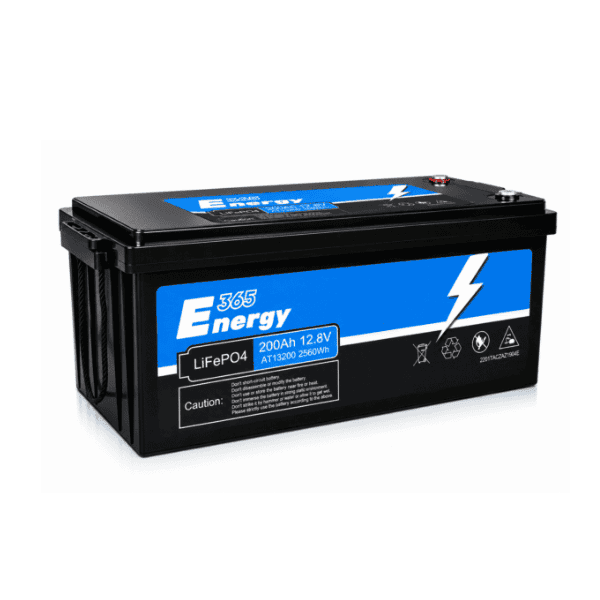

The 12V 200Ah LiFePO4 Lithium Battery is a high-capacity deep-cycle energy storage solution for homes, businesses, solar installations, backup power systems and off-grid applications.
With a 12.8V nominal voltage and 200Ah capacity, the battery provides approximately 2.56kWh (2,560Wh) of nominal stored energy. This makes it a practical option for customers looking for more storage capacity from a compact 12V-class lithium battery.
LiFePO4, or lithium iron phosphate, chemistry is well suited to applications that require repeated charging and discharging. Compared with conventional lead-acid, AGM and gel batteries, lithium technology can provide a longer cycle life, lower maintenance requirements and efficient energy storage.
The battery is particularly suited to solar battery storage, inverter backup systems, off-grid power, load-shedding backup, caravans, camping and other compatible 12V energy-storage applications.
2.56kWh of Nominal Energy Storage
At 12.8V and 200Ah, the nominal energy capacity is:
12.8V × 200Ah = 2,560Wh
That’s equivalent to approximately 2.56kWh of nominal battery capacity.
Actual usable energy will depend on the battery’s operating limits, depth of discharge, temperature, connected equipment and system efficiency.
Designed for Deep-Cycle Use
The LiFePO4 chemistry is designed for repeated charge and discharge cycles, making the battery suitable for applications where the battery is regularly cycled.
The listed product specification indicates a 3,000+ cycle life. Actual battery lifespan depends on factors such as depth of discharge, charging conditions, temperature, storage and operating load.
Suitable for Solar & Inverter Systems
This 12V-class lithium battery can be used as energy storage in appropriately designed:
- Solar power systems
- Inverter systems
- Backup power systems
- Load-shedding solutions
- Off-grid installations
- UPS applications
- Caravan power systems
- Camping and mobile power systems
- 12V energy-storage applications
Always confirm that the inverter, charger or solar controller is configured for LiFePO4 batteries and that its voltage and current limits are compatible with the battery.
Key Features
- 200Ah lithium battery capacity
- 12.8V nominal voltage
- 2.56kWh / 2,560Wh nominal energy
- LiFePO4 lithium iron phosphate chemistry
- Deep-cycle battery design
- 3,000+ claimed cycles
- Suitable for solar energy storage
- Suitable for inverter and backup-power applications
- Suitable for off-grid power systems
- Rechargeable lithium battery technology
- Can be used in appropriately designed battery banks where series/parallel operation is supported
Technical Specifications
| Specification | Details |
|---|---|
| Battery Type | LiFePO4 Lithium Iron Phosphate |
| Nominal Voltage | 12.8V |
| Common System Classification | 12V |
| Nominal Capacity | 200Ah |
| Nominal Energy | 2.56kWh / 2,560Wh |
| Charge Cut-Off Voltage | 14.6V |
| Discharge Cut-Off Voltage | 10V |
| Maximum Discharge | Up to 200A* |
| Cycle Life | 3,000+ cycles* |
| Operating Temperature – Charging | 0°C–45°C* |
| Dimensions | Approx. 522 × 240 × 222mm* |
| Weight | Approx. 16.35kg* |
| Series/Parallel Configuration | Up to 4 series / 4 parallel* |
| Battery Application | Solar, inverter, backup, UPS and off-grid |
*Specifications should be verified against the supplied battery’s current datasheet before being treated as definitive. Current South African listings for this exact 12.8V 200Ah/2.56kWh battery show some variation in discharge-current and cycle-life specifications, so the manufacturer’s documentation should take precedence.
What Does 12V 200Ah Mean?
A 12V 200Ah lithium battery is commonly used to describe this battery class, while the actual nominal voltage is 12.8V.
The 200Ah rating indicates the battery’s nominal capacity, while 12.8V represents its nominal operating voltage.
Together, these ratings provide approximately 2,560Wh or 2.56kWh of nominal energy storage.
How Long Will a 200Ah Lithium Battery Last?
Battery runtime depends on the power being drawn by your appliances.
For example, a load of 500W will consume energy much faster than a 100W load. Runtime is also affected by inverter efficiency, battery operating limits and the amount of energy that can actually be used.
A simple theoretical calculation is:
Runtime ≈ Battery energy ÷ Load
For a 2.56kWh battery and a 500W load:
2.56kWh ÷ 0.5kW = approximately 5.1 hours
This is a theoretical calculation. Real-world runtime will be lower because of conversion losses and the battery’s usable-energy limits.
Is This a 12V or 12.8V Battery?
It is a 12.8V nominal battery, commonly classified and marketed as a 12V lithium battery.
This is why customers may see both 12V 200Ah lithium battery and 12.8V 200Ah LiFePO4 battery used when searching for this type of product.
Why Choose LiFePO4?
LiFePO4 lithium batteries are widely used for energy storage because they offer:
- Long cycle life
- High energy density compared with traditional lead-acid technology
- Low maintenance
- Efficient energy storage
- Stable lithium iron phosphate chemistry
- Good suitability for repeated cycling
For solar and backup applications, this makes LiFePO4 a popular alternative to traditional AGM, gel and lead-acid batteries.
200Ah Lithium Battery for Solar
A 200Ah lithium battery can store solar energy generated during the day for use when solar generation is reduced or unavailable.
A correctly sized solar system can recharge the battery during daylight hours while the battery supplies compatible loads when required.
The solar panels, MPPT controller, inverter and battery should be correctly matched for voltage, charging current and battery chemistry.
200Ah Lithium Battery for Inverters
This battery can be used with a compatible inverter designed for a 12V-class LiFePO4 battery.
When selecting an inverter, consider:
- Continuous inverter power
- Surge requirements
- DC input voltage
- Maximum DC current
- LiFePO4 charging profile
- Battery discharge capability
- Required backup runtime
A larger inverter does not automatically mean the battery can safely supply its full rated output. The complete system must be designed around the battery’s actual discharge and BMS specifications.
Can Multiple Batteries Be Connected?
The product specifications indicate support for series and parallel configurations, allowing appropriately matched batteries to be combined into larger battery banks.
For example, batteries connected in parallel can increase total Ah capacity, while correctly configured series connections can increase system voltage.
Only connect batteries in series or parallel where the manufacturer permits the configuration and all batteries are appropriately matched.
Ideal Applications
Home Backup Power
Use the battery as part of a correctly sized inverter system to provide backup power for selected household loads during power interruptions.
Solar Energy Storage
Store energy produced by solar panels for later use.
Off-Grid Power
Suitable for appropriately designed low-voltage off-grid energy-storage systems.
Caravan & Camping
The 12V-class architecture makes it suitable for compatible mobile power applications.
UPS & Backup Systems
Can provide stored energy for compatible UPS and backup-power equipment.
Important Installation Information
This is a high-capacity lithium battery and should be installed and configured correctly.
Use appropriate:
- DC protection
- Battery cables
- Fusing or circuit protection
- Isolation equipment
- Battery terminals
- Compatible inverter/charger
- LiFePO4-compatible charging equipment
For permanent solar or backup installations in South Africa, installation should be carried out in accordance with applicable electrical requirements and by a suitably qualified professional.
Frequently Asked Questions
What is the capacity of this lithium battery?
The battery has a nominal capacity of 200Ah at 12.8V, equivalent to approximately 2.56kWh or 2,560Wh of nominal stored energy.
Is this a 12V 200Ah lithium battery?
Yes. It is a 12.8V nominal LiFePO4 battery, commonly referred to as a 12V 200Ah lithium battery.
Is it suitable for solar?
Yes. It is suitable for appropriately designed solar energy-storage systems using compatible charging and inverter equipment.
Can I use it with an inverter?
Yes, provided the inverter is compatible with a 12V-class LiFePO4 battery and operates within the battery’s voltage and current specifications.
How many cycles does the battery provide?
The listed specification indicates 3,000+ cycles. Actual cycle life depends on operating conditions, especially depth of discharge, charging and temperature.
What is 2.56kWh?
2.56kWh is the battery’s approximate nominal energy capacity, calculated from 12.8V × 200Ah.
Can it replace a lead-acid battery?
It can potentially replace a suitably sized lead-acid, AGM or gel battery in compatible applications, but the charging profile, voltage, current requirements and physical installation must be checked first.
Can I connect two batteries together?
Multiple batteries may be connected where the manufacturer’s specifications permit series or parallel operation. Batteries should be correctly matched and configured.
Is 12.8V the same as 12V?
Not exactly. 12.8V is the nominal voltage of the LiFePO4 battery, while “12V” is the common system classification used for this battery category.
Is this battery maintenance-free?
LiFePO4 batteries generally require considerably less routine maintenance than flooded lead-acid batteries, but the battery and installation should still be inspected and operated according to the manufacturer’s instructions.
Reviews
There are no reviews yet.